How to Stop Gambling: Start With the Next Decision
Stopping gambling usually becomes easier when you change the environment around the behavior—not just when you promise yourself that the next bet will be the last.
1. Make gambling harder to access
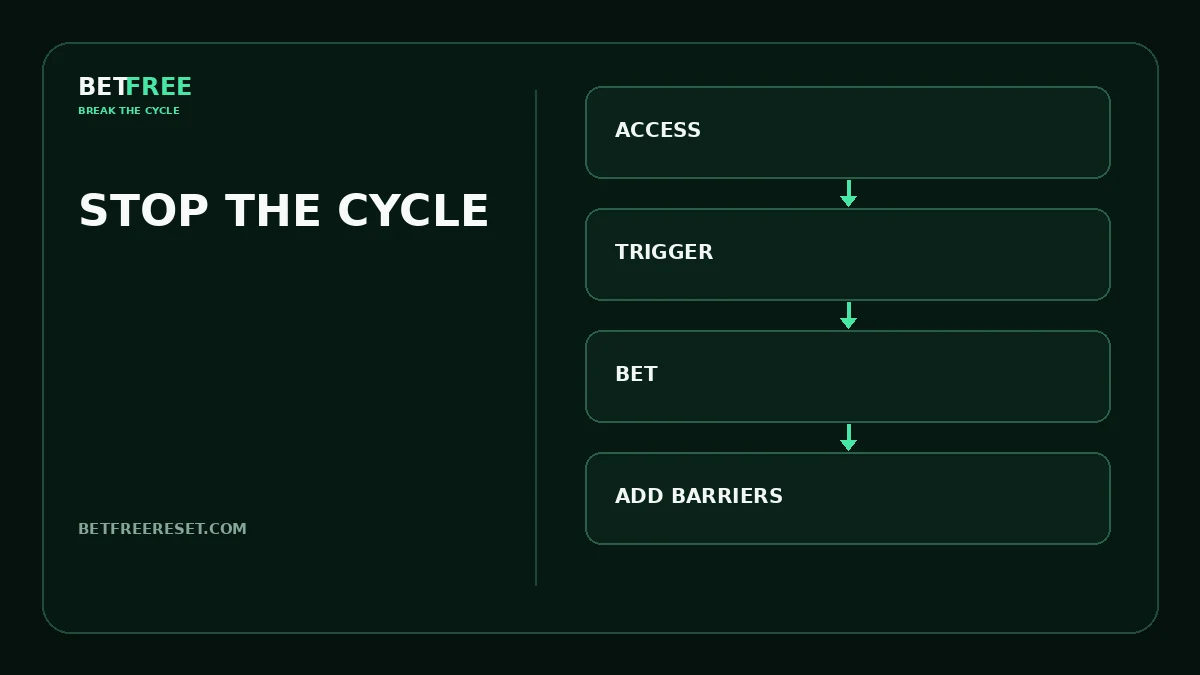
Remove saved payment methods, uninstall gambling apps, use blocking tools where appropriate and consider self-exclusion options available in your country. The goal is to create time between an urge and an action.
2. Protect essential money first
Separate money needed for rent, bills, food, debt payments and savings from anything connected to gambling. Some banks also offer gambling-payment blocks. Do not treat gambling as a way to recover losses or create income.
3. Identify the pattern around your gambling
Ask what tends to happen before you gamble. It might be boredom, stress, loneliness, payday, sports events, alcohol, a loss you want to recover, or simply having easy access to an account.
4. Replace the time, not just the bet
If gambling filled several hours each week, removing it creates an empty space. Plan alternatives before that space appears: exercise, hobbies, time with people who do not gamble, practical tasks, learning or structured entertainment.
5. Tell one person you trust
Keeping the problem completely private can make it easier for the cycle to continue. A trusted person can provide accountability, practical help and a reality check during difficult moments.
6. Get additional help when self-help is not enough
Professional treatment, peer support and specialist gambling services exist. Seeking help is especially important when gambling is causing significant financial harm, relationship problems, persistent loss of control or severe emotional distress.
If the problem feels less like “how do I quit?” and more like “I keep trying and still cannot stop,” read I Can’t Stop Gambling — What Do I Do? for a shorter, immediate next-step plan.
What to do today if you want to stop gambling
You do not need to solve every part of recovery today. Start by making the next bet harder to place and the money needed for everyday life harder to reach from gambling.
- Reduce access: use self-exclusion, device blockers or account restrictions that fit your situation.
- Protect money: move essential bills and living costs out of the path of an impulsive deposit. Use Money Recovery if finances already feel tangled.
- Plan for the next urge: keep Urge Breaker ready instead of relying on willpower in the moment.
- Notice the pattern: use the Trigger Tracker to identify situations that repeatedly come before gambling.
Questions about stopping gambling
What is the first step to stop gambling?
A practical first step is to reduce immediate access to gambling and protect essential money. Self-exclusion, device blockers, banking controls and removing saved payment methods can create useful friction.
Why do I keep gambling even when I want to stop?
Gambling can become tied to triggers, routines, access to money, chasing losses and emotional states. Identifying the pattern around the behavior can make it easier to change the environment instead of relying only on promises.
What should I do when I get a strong urge to gamble?
Delay the decision, change location if possible, reduce access to money or gambling accounts and use a prepared interruption such as BETFREE Urge Breaker or the free Emergency Plan.
Should I self-exclude from gambling?
Self-exclusion can be a strong barrier when gambling access is part of the problem. It is often more useful when combined with device blocking, money protection and support.
Can a 30-day break from gambling help?
A structured break can create space to notice triggers, protect money and rebuild routines, but it is not a guarantee of recovery or a substitute for professional support when that is needed.
Want a structured next step?
BETFREE turns the ideas on this page into a practical 30-day routine focused on awareness, barriers, replacement habits and reflection.
See the 30-Day ResetKeep going with BETFREE
Continue with Gambling Urges · Gambling Relapse, or explore more practical guidance in Free Resources. · Stop Chasing Losses