I Can’t Stop Gambling — What Do I Do?
If you want to stop but keep finding yourself gambling again, do not make the next step another promise. Make the next bet harder to place, protect the money you need for everyday life and put support around the moments when your control is weakest.
What to do in the next 20 minutes
Do not deposit while the urge is active. Close the gambling app or website, leave the venue if you are there, and put distance between yourself and money that can be used to gamble. If possible, tell someone what is happening instead of keeping the decision private. Then use the free 20-minute Emergency Plan to get through the immediate pressure before making another financial decision.
Why can’t I stop gambling even when I want to?
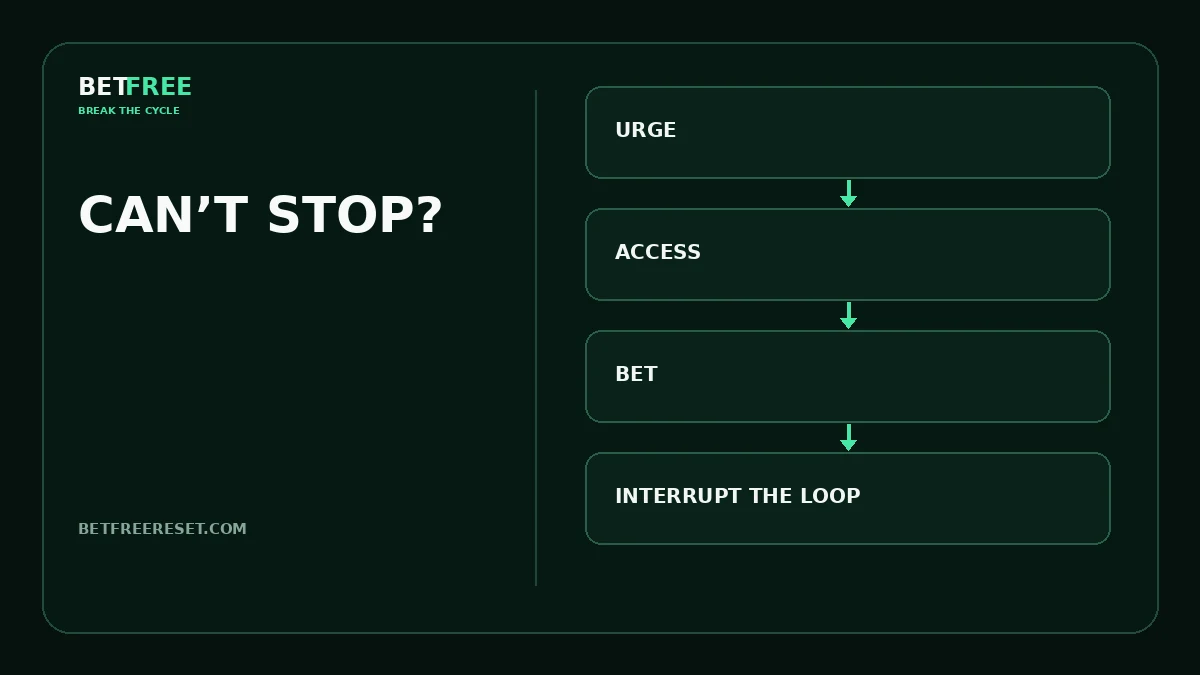
Wanting to stop and being able to stop in a high-risk moment are not always the same thing. Gambling can become tied to stress, boredom, payday, sport, alcohol, late nights, losses, wins and familiar routines. If the accounts, money and triggers around those moments stay unchanged, a promise to stop can be overwhelmed by the same pattern. A stronger plan changes the environment around the decision instead of relying on willpower alone.
Make gambling harder to reach
Use the practical barriers available to you: self-exclusion, gambling blockers, account restrictions, payment controls and changes to how easily gambling money can be accessed. The aim is not to prove that you can resist every urge. It is to reduce the number of moments in which an urge can turn immediately into a bet.
Protect essential money before the next urge
Separate rent, bills, food and other essentials from money that can be reached during an urge. Remove saved payment methods where practical, use banking controls where available and avoid borrowing to gamble or trying to repair losses with another bet. If debt is already part of the situation, start with Gambling Debt: How to Stop the Financial Spiral.
Find the pattern
Ask when gambling is hardest to resist. Is it after payday, during sports, after arguments, late at night, after drinking, after a loss, or after a win? Your pattern tells you where barriers and replacement routines need to be strongest.
What if you have tried to stop before?
Look at the last return to gambling as information. What happened immediately before it? Which account, device, payment method or routine stayed open? Strengthen that specific weak point rather than starting again with the same plan. See Gambling Relapse: What to Do After a Setback.
Build a stronger stop-gambling path
Start with How to Stop Gambling, then add self-exclusion, Urge Breaker and Money Recovery where they match the problem in front of you.
You may need structure, not another promise
BETFREE’s 30-Day Gambling Reset turns stopping into a daily process focused on awareness, barriers, money protection, replacement habits and reflection.
See the 30-Day ResetKeep going with BETFREE
Continue with How to Stop Gambling · Gambling Relapse · Free Emergency Plan, or explore more practical guidance in Free Resources.